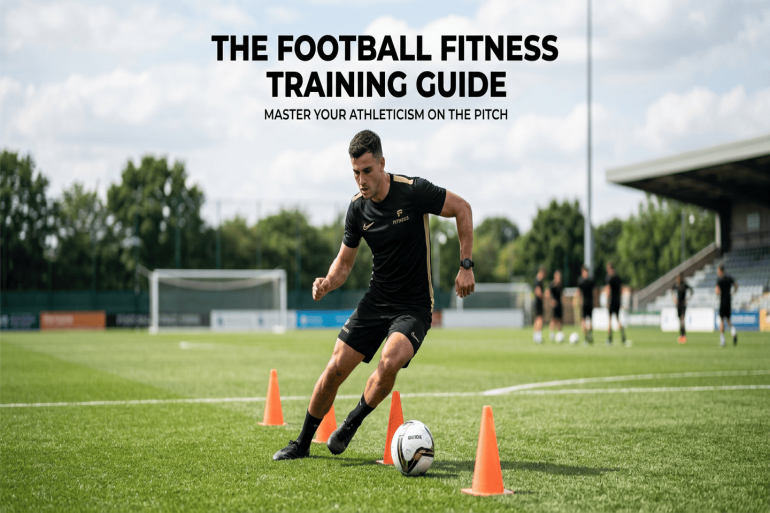
The Ultimate Football Fitness Training Guide
We’ve all been there. It’s the 75th minute of a grueling match. Your lungs are burning, your legs feel like blocks of concrete, and you are praying the referee blows the final whistle. An opponent sprints right past you, and you just don't have the energy to track back.
In modern football, talent alone isn't enough. You could have the footwork of Lionel Messi or the vision of Kevin De Bruyne, but if you run out of gas past the one-hour mark, your skills become useless. Football is a unique, brutal sport. It requires a mixture of long-distance endurance, explosive sprinting power, razor-sharp agility, and physical strength to shrug off defenders.
If you want to step up your game, stop chasing random workouts. You need a structured, football-specific fitness plan. Whether you are prepping for a local Sunday league or trying to stand out in a competitive academy, this ultimate football fitness training guide will transform your conditioning and turn you into an absolute machine on the pitch.
1. The Core Pillars of Football Fitness
Before jumping into individual exercises, you have to understand how a football player's body uses energy. You aren't training to be a marathon runner, nor are you training to be a 100-meter track sprinter. You need to be both.
A standard 90-minute match consists of continuous low-to-moderate jogging interspersed with sudden, explosive, maximal-effort sprints every few minutes. Therefore, your training must focus on three core pillars:
-
Aerobic and Anaerobic Endurance: Building a massive tank to sustain 90 minutes of movement, while teaching your body to recover incredibly fast after heavy sprints.
-
Explosive Speed and Acceleration: Winning the race to a loose ball or beating a defender down the wing.
-
Agility and Change of Direction (COD): The ability to turn, twist, decelerate, and cut quickly without losing balance or pulling a muscle.
Building this combination of endurance, strength, speed, and agility is what separates general fitness from sport-specific conditioning.
2. Endurance: Building an Engine That Never Stops
Many players think building stamina means going for a slow, steady 5-mile jog around the neighborhood. While this helps build a basic baseline, it doesn't prepare you for a real match. Football is a stop-and-start game.
To build true match fitness, you need High-Intensity Interval Training (HIIT) and Fartlek running. These methods perfectly mimic the physiological demands of a real game.
Drill 1: The Football Pitch HIIT Sprint
This is an incredible drill that requires nothing but a football pitch.
-
Start at one corner flag.
-
Jog along the goal line to the other corner flag (Low intensity).
-
Sprint at 90% max effort all the way down the touchline to the opposite corner flag.
-
Walk across the opposite goal line to catch your breath.
-
Sprint again down the remaining touchline.
-
Repeat this loop 6 to 8 times. This teaches your heart to drop its rate rapidly during short breaks, just like during a break in play.
Drill 2: Shuttle Sprints (Without the Ball)
-
Set up four cones in a straight line at distances of 0, 10, 20, and 30 yards.
-
Sprint from 0 to 10 yards, touch the line, and sprint back to 0.
-
Immediately sprint from 0 to 20 yards and back to 0.
-
Finally, sprint from 0 to 30 yards and back to 0.
-
Rest for 60 seconds. Repeat this 4 to 5 times.
3. Speed & Agility: Becoming Uncatchable
Speed in football isn't just about straight-line running; it’s about how quickly you can shift your body weight when an opponent lunges at you. To improve your footwork and reaction time, incorporate these drills twice a week.
The 5-10-5 Agility Drill
-
Place three cones in a straight line, each 5 yards apart. Label them A, B, and C (with B being the center cone).
-
Start at center cone B in a sports stance.
-
Sprint 5 yards to the right to cone C and touch it.
-
Turn sharply and sprint 10 yards all the way to the left to cone A.
-
Turn again and sprint 5 yards back through the middle cone B.
-
Do 5 sets, resting 45 seconds between each. This drill trains your ankles, knees, and hips to handle sudden changes of direction.
Agility Ladder Drills
An agility ladder is one of the cheapest and most effective tools a football player can own. Spend 15 minutes practicing fast footwork variations:
-
Two-Foot Hops: Two feet in each square as fast as possible.
-
The Ickey Shuffle: A lateral movement pattern that forces you to shift your weight side-to-side dynamically.
-
Lateral Quick Steps: Moving sideways through the ladder to sharpen your lateral quickness, vital for defenders tracking wingers.
4. Strength Training: Winning the Physical Battles
Have you ever wondered how players like Erling Haaland or Virgil van Dijk look so immovable on the pitch? It’s not just luck; it’s targeted strength training. You need lower body power to jump for headers and push off defenders, a rock-solid core for balance, and upper body strength to protect the ball.
Focus on these fundamental movements in the gym 2 days a week:
-
Barbell Squats: The holy grail of leg power. Squats build your quadriceps and glutes, which directly boosts your initial acceleration. Aim for 3 sets of 6–8 reps with good form.
-
Bulgarian Split Squats: Football is played primarily on one leg—you shoot on one leg, pass on one leg, and sprint by transferring weight from one foot to another. Single-leg exercises like split squats build stability and eliminate muscular imbalances.
-
Deadlifts (Hex Bar preferred): Great for your hamstrings and lower back. Strong hamstrings act as brakes when you stop running suddenly, which is essential for preventing catastrophic ACL or hamstring tears.
-
Planks and Medicine Ball Rotations: A strong core connects your upper and lower body. When you twist to volley a ball or lean into a defender while shielding, your core is doing all the work.
Strength training is most effective when it is combined with good overall conditioning. For comparison, you can also explore this guide to choosing between gym and yoga for fitness.
5. Merging Fitness with the Ball
While training without the ball is necessary, you ultimately play football with a ball at your feet. Training your fitness while keeping technical control ensures you don't lose your touch when you get tired during a match.
The Cone Weave & Sprint Interval
-
Set up 6 to 8 cones in a straight line, spaced 2 yards apart. Place one final cone 20 yards past the end of the line.
-
Dribble through the cones using quick, short touches as fast as you can.
-
As soon as you exit the last cone, explode into a maximum-effort 20-yard sprint with the ball.
-
Slowly walk back to the start to recover. Repeat 6 times.
6. Sample Weekly Football Fitness Schedule
To make things easy, here is a balanced weekly routine you can follow during your pre-season or off-season to build peak conditioning:
-
Monday: Endurance Day (Pitch HIIT Sprints + 15 minutes of Fartlek running)
-
Tuesday: Strength Training Gym Session (Squats, Deadlifts, Planks)
-
Wednesday: Active Recovery or Rest (Light walking, stretching, foam rolling)
-
Thursday: Speed & Agility Drills (Ladder work, 5-10-5 drills, short acceleration sprints)
-
Friday: Match-Specific Ball Fitness (Cone weave intervals, shooting/dribbling drills under fatigue)
-
Saturday: Match Day or High-Intensity Scrimmage
-
Sunday: Complete Rest and Recovery
On recovery days, gentle mobility work can be useful. If you regularly experience upper-body stiffness from training or long periods of sitting, these gentle yoga poses for neck pain relief can provide another low-intensity option.
7. The Secret Ingredient: Recovery and Nutrition
You can do all the drills in the world, but if you go home and eat fast food while sleeping only 5 hours a night, your fitness will stall.
Your body builds muscle and stamina after the workout, during recovery. Make sure you are sleeping at least 8 hours a night. Drink plenty of water before, during, and after training to prevent cramping. Finally, fuel your body with clean carbohydrates (like rice, oats, and sweet potatoes) for energy, and high-quality protein (like chicken, eggs, fish, or lentils) to repair torn muscle fibers.
Nutrition is especially important around demanding football sessions. For practical meal ideas, check out these best foods to eat before and after a workout to support training and recovery.
For convenient options between meals, you can also choose low-carb, high-protein snacks that provide protein without relying heavily on refined carbohydrates.
Players who want to improve their overall diet can also add more fiber-rich foods to their meals. This guide to high-fiber foods for better digestion offers useful options that can complement a balanced sports diet.
Recovery, Mobility and Injury Prevention
Hard training should always be balanced with adequate recovery. Mobility work can help keep your body moving comfortably between intense sessions, while gradually building strength and conditioning can help you handle the physical demands of football.
For athletes who also experience shoulder tightness or limited upper-body mobility, these yoga poses and stretches for shoulder pain provide another gentle mobility-focused option.
Why Fitness Matters for Modern Athletes
Modern professional athletes are expected to combine technical ability with exceptional physical preparation. Speed, strength, endurance, recovery, and nutrition all contribute to performance.
You can see how important athletic conditioning has become by looking at some of the world's top competitors in our guide to the highest-paid athletes in the world.
Final Thoughts
Building elite football fitness is a marathon, not a sprint. It takes consistency, dedication, and a lot of sweat. But the next time you step onto the pitch, and it’s the 85th minute of a tight game, you will feel the difference. While everyone else is bending over with their hands on their knees, catching their breath, you will be gearing up for one last game-winning sprint.
Tie up your boots, head out to the pitch, and start building your engine today!