Some Weird School Punishments That Actually Happened
We all have been punished for doing something wrong at school. The punishment used to vary depending upon our class, activities, the seriousness of the mistake, and even the teacher's approach. Many of us still feel nostalgic whenever we remember those school days when a teacher would make us stand outside the classroom, write lines, call our parents, or give us some other form of punishment.
School discipline has always been a controversial subject. While reasonable consequences can help children understand rules and responsibility, harsh or humiliating punishments can have the opposite effect. They may create fear, embarrassment, anxiety, or resentment instead of encouraging students to learn from their mistakes.
Interestingly, schools around the world have used some extremely unusual methods of disciplining students. Some of these incidents sound so bizarre that they are difficult to believe. From making students perform uncomfortable tasks to using frightening tactics, these weird school punishments crossed the boundaries of what many people would consider normal discipline.
Before looking at these unusual cases, it is also worth remembering that school life is filled with many memorable experiences. If you enjoy looking back at those times, you can also read about these nostalgic school memories.
Some of the Weirdest School Punishments Reported
Mentioned below are some instances where school punishments reportedly crossed all sorts of limits. These examples are presented as unusual or reported incidents rather than recommendations for disciplining students.
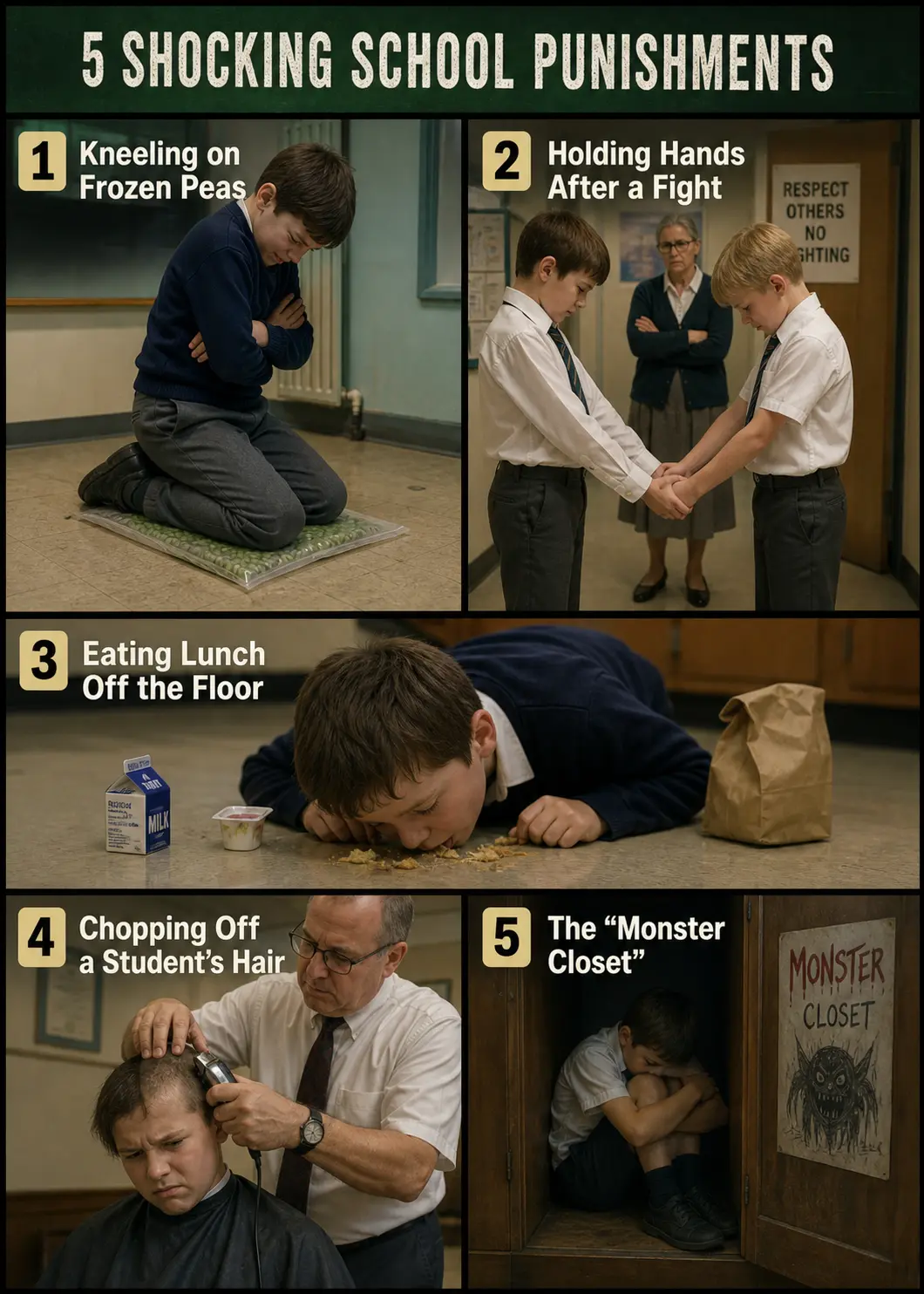
#1 Kneeling on Frozen Peas
One unusual punishment reportedly involved an Asian schoolgirl being made to kneel on frozen peas because of what was described as disobedient behavior. A photograph of the incident went viral, with many people initially misunderstanding what they were seeing.
Using hard or uncomfortable objects as a punishment can be particularly distressing for a child. Instead of helping students understand what they did wrong, physical discomfort may simply make them associate school with fear and embarrassment.
Modern approaches to education increasingly emphasize communication and understanding rather than humiliation. Students are more likely to respond positively when teachers explain why a particular behavior is inappropriate and help them understand its consequences.
#2 Holding Hands After a Fight
This is perhaps one of the more unusual punishments on the list. A high school in Arizona reportedly gave students involved in a fight an unusual choice: face suspension or settle their disagreement by holding hands publicly.
At first glance, the second option sounds almost humorous. However, the idea was reportedly intended to make students deal with the consequences of fighting in a way that encouraged reconciliation rather than another confrontation.
School fights are a serious issue, and simply punishing students may not always address the reason behind the conflict. This is why schools often need broader approaches that include communication, counseling, and preventing bullying in schools.
#3 Eating Lunch Off the Floor
A secondary school in New Jersey was reportedly accused of making students who disrespected food eat their lunch directly from the floor. The alleged intention was to teach students the value of food and make them understand that wasting or disrespecting food was unacceptable.
However, the school reportedly denied the allegation, while some students claimed that such a punishment had taken place. Because accounts of the incident differed, it is difficult to establish every detail with certainty.
Regardless of what happened in this particular case, forcing children to eat from an unhygienic surface is clearly not an appropriate way to teach respect for food. A better approach would be to explain food waste, encourage responsible eating habits, and help students understand why food should not be wasted.
#4 Chopping Off a Student's Hair
One of the most shocking examples involved a teacher who reportedly cut a student's hair as a punishment. The student was reportedly playing in class, and instead of using a conventional disciplinary measure, the teacher took scissors and cut the child's hair.
The incident attracted criticism because hair is closely connected with a person's appearance and identity. Cutting a student's hair without consent can be humiliating and can have a lasting emotional impact.
Discipline should ideally correct behavior without deliberately humiliating a child. Teachers can use classroom rules, conversations with parents, loss of privileges, or other educational consequences instead.
#5 The "Monster Closet"
Perhaps the most disturbing example on this list involved a teacher using fear to discipline young children.
A teacher reportedly told students about a closet where a monster supposedly lived. The story was used to frighten children and make them behave. On one occasion, a four-year-old girl was reportedly locked in the room containing the closet as a form of punishment.
The situation became even more disturbing when other students reportedly laughed at the punishment and were subsequently placed in the same room with the lights switched off. According to reports, some children became so frightened that they became physically ill, while others reportedly lost control of their bladder.
Using fear against very young children can be especially harmful because they may not have the emotional maturity to understand that a frightening story is fictional. What an adult considers a joke or lesson can feel completely real to a child.
Why Harsh School Punishments Can Be Harmful
School discipline is necessary because students need boundaries and structure. However, there is an important difference between teaching accountability and deliberately humiliating a child.
Extreme punishments can potentially create several problems:
- Fear of school: Children may begin associating teachers and classrooms with fear rather than learning.
- Loss of confidence: Public humiliation can negatively affect a student's self-esteem.
- Resentment toward teachers: Harsh treatment can damage the relationship between students and educators.
- Emotional distress: Frightening or humiliating punishments can be particularly difficult for younger children.
- More aggressive behavior: Children may learn that punishment and humiliation are acceptable ways of dealing with problems.
These concerns are especially important when dealing with bullying. Schools need to create an environment where students feel comfortable reporting problems instead of being afraid to speak up. You can also read about signs of depression in teenagers to understand why emotional well-being deserves attention during the school years.
What Should Schools Do Instead?
Not every mistake requires a severe punishment. In many situations, the goal should be to help students understand what went wrong and give them an opportunity to correct their behavior.
1. Talk to the Student
A calm conversation can often reveal why a student behaved inappropriately. The teacher can explain the problem and allow the child to share their side of the story.
2. Use Logical Consequences
A consequence should ideally be connected to the behavior. For example, a student who damages classroom property could participate in an appropriate process of repairing or replacing it rather than being publicly humiliated.
3. Involve Parents When Necessary
For repeated or serious behavioral problems, communicating with parents or guardians can help teachers understand the student's situation and develop a more effective solution.
4. Encourage Positive Behavior
Discipline does not always have to focus on mistakes. Recognizing students when they cooperate, help others, complete their responsibilities, or show improvement can encourage positive behavior.
5. Teach Conflict Resolution
When students fight or argue, simply punishing them may not solve the underlying problem. Teaching communication, empathy, and conflict-resolution skills can help students handle disagreements more constructively.
School Discipline Has Changed Over Time
School discipline has changed considerably over the years. Older generations may remember punishments such as standing outside the classroom, writing lines repeatedly, or being reprimanded in front of classmates.
Today, many educators place greater emphasis on understanding student behavior and using constructive disciplinary methods. The objective is not simply to make a student afraid of making another mistake but to help them understand why the behavior was inappropriate.
This shift is particularly important because schools play a major role in shaping children's social behavior. Education is not limited to textbooks and examinations. Students also learn communication, responsibility, empathy, and decision-making in the classroom.
For students looking for ways to improve academically, practical strategies can also make a difference. For example, these simple exam preparation tips can help students approach their studies more effectively.
School Punishments Should Teach, Not Terrify
The unusual punishments mentioned above may sound unbelievable, but they also highlight an important question: what should the purpose of school discipline actually be?
A punishment should ideally help a student understand their mistake and make a better decision in the future. Making a child frightened, embarrassed, or physically uncomfortable does not necessarily teach them how to behave better.
Teachers have an enormous influence on students, especially younger children. A supportive teacher can turn a mistake into a learning experience, while an unnecessarily harsh response can turn the same incident into a lasting negative memory.
Final Thoughts
Schools need rules because classrooms cannot function without discipline. However, the way those rules are enforced matters just as much as the rules themselves.
From kneeling on frozen peas and eating lunch from the floor to frightening children with stories about monsters, the examples in this article show just how unusual school punishments can become. Some incidents have been disputed or reported differently by different sources, so they should be viewed as examples of unusual disciplinary stories rather than established models of school discipline.
The best discipline should help students learn from their mistakes while preserving their dignity and emotional well-being. After all, school should ultimately be a place where children feel safe enough to learn, make mistakes, ask questions, and grow.
If you are interested in revisiting the lighter side of school life, you can also explore more memorable school experiences and see how different school memories can stay with us long after graduation.