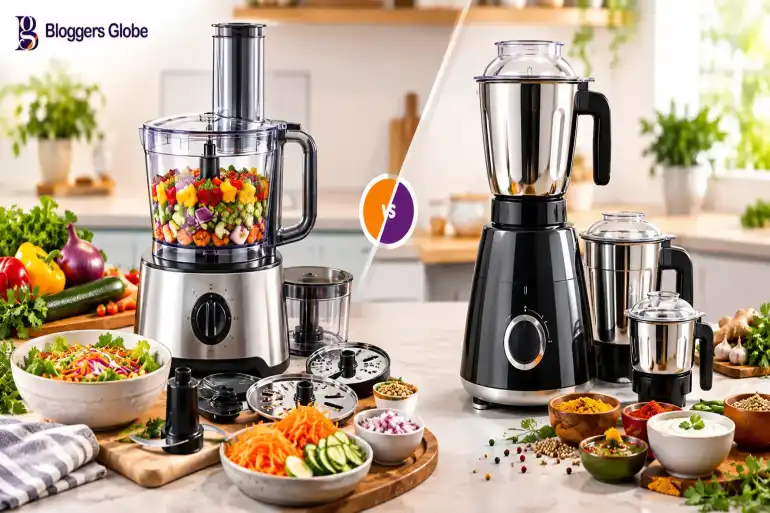
Best Food Processor for Home Cooking: Food Processor vs Mixer Grinder Guide 2026
Buying a food processor can seem simple until you start comparing models, motor power, bowl sizes, attachments, and prices. Then another question usually appears: should you buy a food processor or a mixer grinder?
For home cooking, the best choice is not always the most powerful or expensive appliance. It depends on what you cook, how much food you prepare, and whether you need chopping, slicing, shredding, kneading, grinding, or blending.
This guide explains the differences between these appliances and helps you decide what type of food processor is best for home cooking before you buy.
Best Food Processor for Home Cooking: Quick Guide
If you regularly chop vegetables, grate ingredients, slice potatoes, shred vegetables, prepare salads, or knead dough, a food processor can save a lot of preparation time.
However, if most of your cooking involves grinding spices, making chutneys, preparing purees, blending smoothies, or making batters, a mixer grinder may be more useful.
For many Indian kitchens, the decision is therefore less about finding one appliance that does everything and more about choosing the machine that matches your everyday cooking.
Food Processor vs Mixer Grinder: What's the Difference?
The easiest way to understand the difference is to look at the type of work each appliance is designed to handle.
| Kitchen Task | Food Processor | Mixer Grinder |
|---|---|---|
| Chopping vegetables | Excellent | Limited |
| Slicing vegetables | Excellent | Not ideal |
| Shredding and grating | Excellent | Limited |
| Kneading dough | Very useful | Usually not its main purpose |
| Grinding spices | Limited depending on model | Excellent |
| Making chutneys | Possible on some models | Excellent |
| Making smoothies | Possible depending on attachments | Excellent |
| Large-batch food preparation | Excellent | Less convenient |
A food processor is mainly a food preparation appliance. A mixer grinder is mainly a grinding and blending appliance.
That distinction is important because buying a multi-function appliance does not automatically mean it will perform every task equally well.
Who Should Buy a Food Processor?
A food processor can be a particularly useful choice for people who spend a lot of time preparing ingredients before cooking.
-
You regularly chop large quantities of vegetables.
-
You make salads and need consistent slicing or shredding.
-
You frequently grate vegetables, cheese, or other ingredients.
-
You knead dough for roti, paratha, pizza, or baking.
-
You cook for a family and prepare larger quantities.
-
You enjoy baking and need help with mixing or dough preparation.
-
You want one appliance for several food-preparation tasks.
If chopping onions, slicing vegetables, grating ingredients, and kneading dough are regular parts of your cooking routine, a food processor can be a genuine time-saving appliance.
Who May Not Need a Food Processor?
A food processor is not automatically a must-have kitchen appliance.
If your cooking mainly involves grinding masalas, preparing chutneys, blending tomato puree, making smoothies, or preparing wet and dry pastes, your existing mixer grinder may already handle most of your needs.
You may also want to skip a food processor if you have very little kitchen storage space. The main bowl, blades, discs, and other accessories can take considerably more space than a basic mixer grinder.
Food Processor vs Chopper: Which One Should You Buy?
This is another common comparison when shopping for kitchen appliances.
An electric chopper is generally designed for simpler jobs such as chopping onions, garlic, herbs, or small quantities of vegetables. A food processor usually offers a wider range of functions through different blades and discs.
| Feature | Chopper | Food Processor |
|---|---|---|
| Small chopping jobs | Excellent | Excellent |
| Slicing | Usually limited | Excellent |
| Shredding | Usually limited | Excellent |
| Kneading dough | No | Available on suitable models |
| Multiple attachments | Few | Many |
| Storage space | Low | Higher |
| Best for | Quick small jobs | Regular multi-purpose preparation |
If you only need to chop onions occasionally, buying a large food processor may be unnecessary. But if you want one machine for chopping, slicing, shredding, and dough preparation, a food processor makes more sense.
What to Look for When Buying a Food Processor
Once you know that a food processor fits your cooking style, the next step is choosing the right one.
1. Motor Power
Motor power is one of the specifications shoppers notice first, but higher wattage does not automatically mean better performance.
Think about the jobs you will perform most often. Light chopping and slicing require less power than demanding tasks such as regular dough preparation or processing larger quantities.
Instead of choosing a model simply because it has the highest wattage, look at the manufacturer's recommended capacity and intended uses as well.
2. Bowl Capacity
Bowl size matters if you regularly cook for several people.
A small bowl may be perfectly adequate for one or two people, but larger families may find a bigger processing bowl more convenient because fewer batches are required.
At the same time, an oversized bowl can be inconvenient if you usually prepare very small quantities. Choose capacity according to your normal cooking habits rather than choosing the biggest option available.
3. Blades and Attachments
The attachments can determine how useful a food processor becomes in your kitchen.
Depending on the model, you may find chopping blades, slicing discs, shredding discs, dough blades, citrus juicers, whipping attachments, or additional jars.
More attachments sound attractive, but don't pay extra for accessories you are unlikely to use.
4. Dough-Kneading Capability
If you regularly make roti, paratha, pizza, bread, or other dough-based recipes, check whether the machine is specifically designed for kneading.
Also look at the recommended dough quantity. A processor that works well for a small batch may not be the right choice for someone preparing dough for a large family.
5. Speed and Pulse Control
Different ingredients need different levels of processing.
Variable speeds can give you more control, while a pulse function can be useful when you want to chop ingredients without turning them into a puree.
This is particularly helpful when preparing vegetables, nuts, herbs, and other ingredients where texture matters.
6. Cleaning and Storage
A food processor can save preparation time but may add cleaning work because it has several removable parts.
Before buying, check how easily the bowl, lid, blades, discs, and other attachments can be removed and cleaned.
Also consider where you will store the accessories. A machine that stays packed away in a cupboard may be less useful than one that is easy to access on your kitchen counter.
7. Safety Features
Look for practical safety features such as a secure locking mechanism, stable base, overload protection, and a lid that locks properly before operation.
Always follow the manufacturer's instructions and avoid handling sharp blades while the appliance is connected to power.
Is a Food Processor Worth It for an Indian Kitchen?
For many Indian households, the answer depends heavily on cooking style.
If you frequently chop vegetables, knead atta, grate ingredients, prepare salads, or cook large meals, the appliance can reduce repetitive preparation work.
But if your main requirements are grinding spices, making chutneys, preparing batters, and blending ingredients, a mixer grinder may remain the more important appliance.
For people who cook a variety of meals, having both appliances can make sense because they perform different jobs rather than completely replacing one another.
Common Food Processor Buying Mistakes
Many buyers concentrate on the number of attachments or motor wattage and overlook how they will actually use the appliance.
-
Buying the biggest model without considering kitchen space.
-
Choosing wattage alone instead of looking at overall design and capacity.
-
Paying for attachments that will rarely be used.
-
Assuming a food processor will completely replace a mixer grinder.
-
Ignoring cleaning and storage requirements.
-
Not checking the recommended quantity for dough or other heavy tasks.
-
Choosing a model without considering warranty and after-sales support.
How a Food Processor Can Make Home Cooking Easier
The biggest advantage of a food processor is not simply that it performs more functions. It is that it can reduce repetitive preparation work.
For example, preparing vegetables for a large family meal can involve chopping, slicing, and shredding several ingredients separately. A suitable processor can make these tasks faster and more consistent.
This can be particularly useful when you are trying to prepare more meals at home. Keeping fresh ingredients ready can make everyday cooking easier, especially when you know how to store fruits and vegetables properly.
For healthier meal preparation, you can also combine convenient food preparation with nutrient-rich ingredients such as the high-fiber foods for better digestion covered in our food guide.
Food Processor Buying Checklist
Before clicking the Buy button, ask yourself these questions:
-
What tasks do I perform most often?
-
Do I need chopping, slicing, shredding, or kneading?
-
Do I already own a good mixer grinder?
-
How many people do I normally cook for?
-
How much counter and storage space do I have?
-
Which attachments will I actually use?
-
Is the bowl large enough for my normal quantities?
-
Does the model have suitable safety features?
-
Is cleaning reasonably easy?
-
What warranty and service support are available?
Which Food Processor Is Best for You?
There is no single food processor that is perfect for every home.
Choose a food processor if your priority is chopping, slicing, shredding, grating, kneading, and larger food-preparation tasks.
Choose a mixer grinder if your priority is grinding spices, making chutneys, blending, pureeing, and preparing batters.
Choose a smaller chopper if you only need quick chopping for small quantities and don't need multiple functions.
And if you cook a wide variety of Indian and international dishes, using a food processor alongside a mixer grinder may provide more practical flexibility than expecting one appliance to do everything.
Final Verdict
The best food processor for home cooking is not necessarily the model with the highest wattage, the largest number of attachments, or the highest price.
The better approach is to start with your cooking routine. If chopping, slicing, shredding, grating, and kneading take up a significant amount of your preparation time, a food processor can be a worthwhile kitchen upgrade.
If grinding and blending are your main requirements, a mixer grinder may be the smarter choice.
Before buying, compare the motor, bowl capacity, attachments, dough capacity, speed controls, cleaning requirements, safety features, warranty, and service support. Most importantly, compare those features against the tasks you actually perform at home.
That simple approach can help you avoid paying for features you don't need and choose a food processor that genuinely makes everyday cooking easier.
Frequently Asked Questions
What is the best food processor for home cooking?
The best food processor depends on your cooking habits. Look for a model with the right bowl capacity, suitable motor power, useful attachments, easy cleaning, and reliable safety and service support.
Is a food processor better than a mixer grinder?
Neither is better for every task. A food processor is generally more useful for chopping, slicing, shredding, grating, and kneading, while a mixer grinder is better suited to grinding, blending, chutneys, and many batter or paste preparations.
Is a food processor worth buying?
A food processor can be worth buying if you regularly spend time chopping vegetables, slicing ingredients, shredding, grating, or kneading dough. If you rarely perform these tasks, a smaller appliance or your existing mixer grinder may be enough.
Is a food processor useful for Indian cooking?
Yes. It can be useful for vegetable preparation, shredding, slicing, chopping, grating, and dough preparation. However, a mixer grinder may still be preferable for tasks such as fine masala grinding, chutneys, and certain batters.
How much motor power should a food processor have?
There is no single wattage that is ideal for everyone. Choose according to the jobs you expect to perform, the quantity you normally process, and the manufacturer's recommended capacity. Heavy dough preparation generally requires more capability than occasional chopping.