
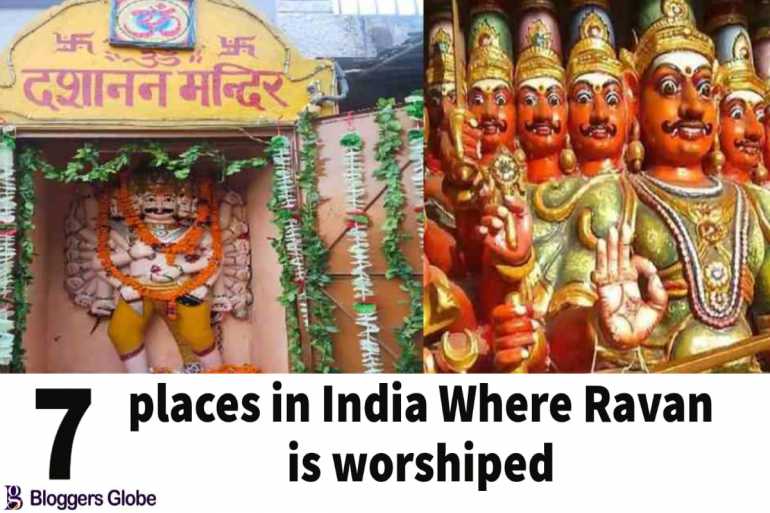
7 Places in India Where Ravana Is Worshipped Instead of Burnt on Dussehra
On the tenth day of Navratri, Hindus across India celebrate Dussehra, also known as Vijayadashami. In many parts of the country, the festival is associated with the burning of Ravana's effigy, symbolising the victory of good over evil and the defeat of Ravana by Lord Rama.
However, Dussehra is not observed in exactly the same way everywhere. In some communities and locations, Ravana is remembered and worshipped rather than represented only as a villain. Some people revere him for his knowledge, scholarship and devotion to Lord Shiva, while others follow local traditions connected with his family or ancestry.
This makes the cultural traditions surrounding Ravana surprisingly diverse. There are places where people do not burn his effigy on Dussehra and instead offer prayers or observe the day in a different way.
Here are 7 places in India associated with Ravana worship or traditions in which his effigy is not burned. Many of the stories behind these practices are based on local beliefs and oral traditions, so they should be understood in that cultural context rather than as historically established facts.
Why Is Ravana Worshipped in Some Parts of India?
Ravana is generally portrayed as the antagonist in the Ramayana tradition because of his conflict with Lord Rama and the abduction of Sita. At the same time, several communities remember other aspects of his character, including his learning, knowledge of scriptures, association with Lord Shiva and status as a powerful ruler.
Because Indian religious traditions have developed differently across regions and communities, Ravana's image is not interpreted identically everywhere. In some places, local traditions honour him as a scholar, ancestor, devotee of Shiva or family connection.
It is therefore more accurate to say that some communities worship or revere Ravana rather than suggesting that an entire city or state follows the same tradition.
1. Mandsaur, Madhya Pradesh
Mandsaur is one of the best-known places in India associated with Ravana worship. In the Khanpura area, the Namdev community traditionally regards Ravana as their son-in-law because of the local belief that Mandodari, Ravana's wife, was associated with the area.
According to local tradition, Ravana is respected here for his knowledge and devotion to Lord Shiva. Instead of treating him only as a figure whose effigy must be burned, devotees gather around his statue and offer prayers during Dussehra.
Reports have also noted that the local community considers burning Ravana's effigy disrespectful to the tradition they follow. The connection between Mandsaur and Mandodari is a matter of local belief rather than established archaeological history.
Therefore, Mandsaur's Dussehra tradition offers an interesting example of how the same mythological figure can be remembered differently by different communities.
2. Bisrakh, Uttar Pradesh
Bisrakh, near Greater Noida in Uttar Pradesh, is another famous place associated with Ravana. Local residents believe that Ravana was born here and connect the name of the village with his father, Sage Vishrava.
The village is known for its different approach to Dussehra. Rather than celebrating Ravana's death with the traditional effigy burning, residents have historically observed the occasion through prayers, rituals and remembrance.
Local residents regard Ravana as an ancestor and a learned figure. Recent reports continue to describe Bisrakh as a place where Ravana is remembered with respect rather than simply being portrayed as an evil character. :contentReference[oaicite:2]{index=2}
The traditions of Bisrakh are particularly interesting because they demonstrate how local oral history and religious practice can create a distinctive interpretation of a well-known epic character.
3. Gadchiroli, Maharashtra
Parts of Gadchiroli in Maharashtra have traditions among Gond communities in which Ravana is remembered with respect. Some members of these communities identify Ravana with a Gond cultural tradition and do not view him exclusively through the conventional good-versus-evil narrative.
Local accounts describe Ravana as a knowledgeable ruler and devotee of Lord Shiva. Rituals and community observances associated with Ravana can therefore look very different from the large-scale effigy burning commonly seen elsewhere during Dussehra.
These traditions should be understood as community-specific beliefs rather than as a representation of how everyone in Gadchiroli views Ravana. Reports have documented Ravana-related worship and traditions among sections of Gond communities in the region. :contentReference[oaicite:3]{index=3}
4. Baijnath, Himachal Pradesh
Baijnath in Himachal Pradesh is closely associated with stories about Ravana's devotion to Lord Shiva. Local tradition says that Ravana performed intense penance to please Shiva in this region.
Because of this association, Ravana is remembered here primarily through his identity as a devotee of Lord Shiva. The local religious tradition differs from places where Dussehra centres on burning his effigy.
Baijnath is therefore frequently mentioned among Indian locations where Ravana's connection with Shiva is an important part of the local religious narrative. :contentReference[oaicite:4]{index=4}
5. Kanpur, Uttar Pradesh
Kanpur has a well-known Dashanan Temple dedicated to Ravana in the Shivala area. The name Dashanan refers to the traditional description of Ravana as the ten-headed king.
Unlike an ordinary temple that remains open throughout the year, reports have described the temple as being especially associated with Dussehra, when devotees gather to offer prayers to Ravana.
The tradition focuses on remembering Ravana as a learned devotee of Lord Shiva. The temple's unusual Dussehra observance makes it one of the better-known examples of Ravana worship in northern India. :contentReference[oaicite:5]{index=5}
6. Kolar and Malavalli, Karnataka
Some traditions in Karnataka also associate Ravana with worship, particularly around Kolar and Malavalli. Ravana is remembered in these traditions as a powerful figure and devotee of Lord Shiva.
Local beliefs and practices can vary from one community to another. In some places, the emphasis is not on burning an effigy but on remembering Ravana through religious or cultural observances.
This is another example of why Dussehra traditions cannot be described in exactly the same way across every part of India.
7. Ravanagram, Vidisha, Madhya Pradesh
Another unusual tradition can be found in Ravanagram near Vidisha in Madhya Pradesh. The village has a temple associated with Ravana, and local residents have traditionally remembered him as a learned figure.
Reports have described Ravana being worshipped in the village during Dussehra and on important family occasions. The local tradition is particularly interesting because it differs from the widespread practice of celebrating his defeat with an effigy burning.
Ravanagram is therefore another place that demonstrates the regional diversity surrounding stories and traditions connected with Ravana. Historical reports have documented Ravana worship in the Vidisha region. :contentReference[oaicite:6]{index=6}
Other Places Associated With Ravana Worship
The seven places above are not the only locations in India where Ravana is remembered or worshipped. Reports and travel features have also documented Ravana-related temples and traditions in places such as Kakinada in Andhra Pradesh and Jodhpur in Rajasthan.
In Kakinada, Ravana's devotion to Lord Shiva forms an important part of the local temple tradition. In parts of Jodhpur, certain communities have traditions connecting themselves with Ravana's lineage and observe Dussehra differently.
This wider list shows that Ravana worship is not confined to one region or one particular interpretation. Instead, different communities have developed their own ways of remembering the character. :contentReference[oaicite:7]{index=7}
Why Is Ravana Burned on Dussehra?
In the most widely recognised Dussehra tradition, Ravana's defeat by Lord Rama represents the victory of good over evil. In many parts of India, large effigies of Ravana, and sometimes Kumbhakarna and Meghnad, are burned during Vijayadashami celebrations.
The symbolism is broader than the character himself. The burning of the effigy is commonly interpreted as a reminder that arrogance, injustice and wrongdoing ultimately lead to destruction.
At the same time, communities that worship Ravana do not necessarily reject the wider meaning of Dussehra. Their traditions simply place greater emphasis on other aspects of Ravana's identity, such as knowledge, devotion or ancestry.
Why Do Different Communities View Ravana Differently?
Indian epics and religious traditions have been transmitted through texts, oral traditions, regional performances and community practices for centuries. As a result, characters from the Ramayana can have different cultural meanings in different parts of the country.
For many people, Ravana represents arrogance and wrongdoing. For some communities, he also represents scholarship, power, devotion to Shiva or an ancestral connection. These interpretations can coexist within the broader cultural landscape of India.
It is important to describe these traditions respectfully and accurately rather than suggesting that one regional belief represents the views of all Hindus or all Indians.
Dussehra in India: One Festival, Many Traditions
Dussehra is celebrated in many different ways across India. In some regions, the focus is on Lord Rama's victory over Ravana. In others, Vijayadashami is associated with Goddess Durga's victory over Mahishasura. Cultural performances, processions, prayers and local rituals also vary widely.
This diversity is one of the most fascinating aspects of India's festivals. A festival may have a common name and broad cultural significance while still being celebrated differently from one state, community or town to another.
As the Dussehra season is closely followed by Diwali, readers interested in the larger festive calendar can also check the Diwali 2026 festival calendar to see the dates and traditions associated with the five-day celebration.
Interesting Facts About Ravana Worship in India
- Ravana is worshipped or revered by certain communities in several parts of India.
- Bisrakh in Uttar Pradesh is traditionally believed by local residents to be Ravana's birthplace.
- Mandsaur is associated with the local tradition that Mandodari, Ravana's wife, belonged to the region.
- Some communities remember Ravana for his scholarship and devotion to Lord Shiva.
- The Dashanan Temple in Kanpur is particularly associated with Dussehra worship.
- Gond communities in parts of central India have distinctive traditions associated with Ravana.
- Not every local tradition described as “Ravana worship” means that an entire city or district worships him.
- Many of the stories connecting Ravana with particular places are based on local beliefs, legends and oral traditions.
Frequently Asked Questions
Where is Ravana worshipped in India?
Ravana is associated with worship or reverence in places including Bisrakh in Uttar Pradesh, Mandsaur and Ravanagram in Madhya Pradesh, Baijnath in Himachal Pradesh, Kanpur in Uttar Pradesh, parts of Gadchiroli in Maharashtra and parts of Karnataka. The nature of the tradition differs from place to place.
Where is Ravana not burnt on Dussehra?
Bisrakh, Mandsaur and some communities in other regions are known for traditions in which Ravana is not treated in the same way as in the widespread effigy-burning tradition. The exact Dussehra practice can vary between communities and locations.
Why is Ravana worshipped in Bisrakh?
Local residents of Bisrakh believe that Ravana was born there and regard him as an ancestor. The village therefore has traditions of remembering Ravana rather than celebrating his death through the usual effigy-burning ceremony. :contentReference[oaicite:8]{index=8}
Why is Ravana worshipped in Mandsaur?
A local tradition connects Mandsaur with Mandodari, Ravana's wife. Because she is regarded in the tradition as being from the area, Ravana is remembered as a son-in-law and is worshipped by sections of the local community. :contentReference[oaicite:9]{index=9}
Is there a Ravana temple in Kanpur?
Yes. Kanpur has the Dashanan Temple in the Shivala area, which is associated with Ravana worship and is particularly known for its Dussehra observance. :contentReference[oaicite:10]{index=10}
Why is Ravana associated with Lord Shiva?
In Hindu traditions and popular retellings of the Ramayana, Ravana is often described as a devoted follower of Lord Shiva. This aspect of his character is especially important in places where Ravana is remembered or worshipped as a Shiva devotee.
Conclusion
Dussehra is commonly associated with the burning of Ravana's effigy, but India's cultural traditions are much more diverse than a single form of celebration. In places such as Mandsaur, Bisrakh, Baijnath, Kanpur, parts of Gadchiroli, Karnataka and Ravanagram, Ravana is remembered through local traditions of worship, respect or remembrance.
These traditions do not necessarily change the wider significance of Dussehra. Instead, they show how mythology and cultural memory can be interpreted differently by different communities.
The stories surrounding these places are a fascinating part of India's cultural diversity. Some are supported by documented local practices, while many of the connections between Ravana and particular places remain matters of belief, legend and oral tradition. Understanding that distinction makes these traditions even more interesting.
For readers looking at India's festivals beyond Dussehra, our guide to India's major Hindu festivals provides another look at how different festivals have developed their own regional customs.
Hindi readers can also read the Hindi version of Ravana worship traditions for the same topic.


