
Unique Cultures Around the World: 10 Fascinating Traditions and Customs
The world is home to thousands of cultures, each shaped by its own history, beliefs, environment and way of life. Some traditions may seem unusual to outsiders, but they often have deep cultural meanings for the communities that practice them.
From mourning rituals and ancestor ceremonies to distinctive festivals and traditional customs, these practices show how differently people around the world understand family, death, spirituality and community. Here are some fascinating cultural traditions from different parts of the world.
1. Finger-Cutting Tradition of the Dani People
The Dani people of Papua, Indonesia, have traditionally practiced a mourning custom known as finger cutting. The practice has been associated particularly with women and is understood as a physical expression of grief after the death of a close family member.
Research on the tradition describes finger cutting as having social, emotional and cultural meanings, including expressing affection for deceased relatives and sharing the pain of loss. The practice is not something that should be viewed simply as a bizarre custom; it is connected to the community's traditional understanding of grief and family relationships.
2. Ritual Endocannibalism Among the Yanomami
Endocannibalism refers to the ritual consumption of remains belonging to a deceased member of one's own community. One of the best-known examples is associated with the Yanomami people of the Amazon.
In the traditional funerary practice described by anthropological sources, the body is left in the forest and the bones are later collected and cremated. The ashes may then be mixed into a banana-based soup and consumed by members of the community.
The ritual has been understood as part of the community's way of dealing with death, remembrance and the relationship between the living and the deceased. It is therefore important to understand the practice within its cultural and spiritual context rather than judging it by modern expectations.
3. Ma'nene: Caring for the Dead in Toraja
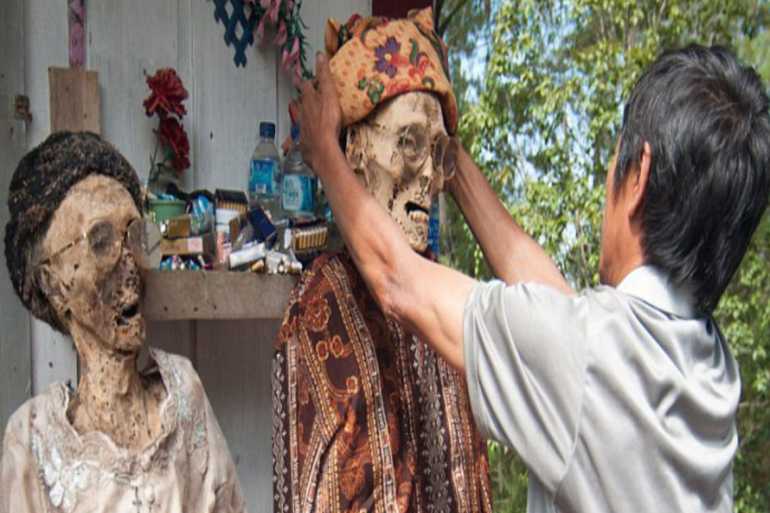
The Toraja people of South Sulawesi, Indonesia, are known for the Ma'nene ritual. During this tradition, families may remove the remains of ancestors from their resting places, clean them and replace their clothes before returning them to their resting place.
The ritual is connected with honoring and remembering ancestors. In some communities, Ma'nene is held periodically and also provides an opportunity for family members to come together.
What may look unusual to outsiders is therefore connected to a much deeper idea: family relationships continue to have meaning even after death.
4. Ashura and Traditional Mourning Rituals
Ashura, observed on the 10th day of Muharram, has special significance for Shi'a Muslims because it commemorates the martyrdom of Imam Hussein at Karbala. Mourning practices can include processions, elegies, chest beating and other forms of remembrance.
Some Shi'a communities have historically practiced forms of self-flagellation or other forms of ritual self-mortification. However, these practices are not followed by all Shi'a Muslims, and mourning customs differ considerably between communities and regions.
The central purpose of Ashura in Shi'a tradition is remembrance and mourning for Imam Hussein and the tragedy of Karbala.
5. Strong Bonds With Ancestors
In several traditional societies, the relationship between a family and its ancestors remains an important part of cultural life. Ancestors may be remembered through ceremonies, offerings, prayers, family gatherings or special occasions.
These traditions show that different societies have developed their own ways of understanding the connection between past and present generations. For many communities, remembering ancestors is closely linked with family identity and cultural continuity.
6. Food as Part of Cultural Identity
Food is much more than something people eat. Traditional dishes, preparation methods and eating customs can preserve centuries of cultural history.
India itself provides countless examples of food becoming part of cultural identity. Tea, for example, has developed into an important part of everyday social life in many parts of the country. You can also explore the culture of chai in India to see how a simple drink can become part of social traditions.
7. Different Ways of Mourning
There is no single way to express grief. Around the world, communities have developed different mourning customs based on their religious beliefs, history and social traditions.
Some communities use periods of silence, while others hold large gatherings, processions, songs or ceremonies. Clothing, food and memorial rituals can also play an important role.
These differences remind us that grief is universal, but the way people express it can vary greatly from one culture to another.
8. Festivals That Preserve Ancient Traditions
Festivals are another important way cultures preserve their history. Music, dance, clothing, food and religious ceremonies can all become part of a festival and pass traditions from one generation to the next.
India is particularly diverse in this regard, with festivals reflecting different religions, regions and communities. Understanding Indian festival traditions is one way to appreciate how culture continues to evolve while retaining its historical roots.
9. Traditions Can Change With Time
Not every traditional practice remains unchanged. Some customs gradually disappear, while others survive in modified forms. Social change, education, urbanization, laws and changing attitudes can all influence how traditions are practiced.
This is particularly important when reading about unusual cultural practices online. A tradition described in an old article may no longer be commonly practiced in exactly the same way today.
10. Understanding Culture Without Judging It
One of the biggest lessons these traditions offer is that something unfamiliar is not necessarily meaningless. A custom that looks unusual from the outside may have a strong historical, religious or emotional significance for the people who practice it.
Travel can be a great way to understand these differences firsthand. If you enjoy learning about how visiting new places can broaden your perspective, read about the benefits of travelling and discovering different communities.
Final Thoughts
The world's cultures are incredibly diverse, and traditions that seem unusual at first can reveal important ideas about family, spirituality, grief, identity and community.
The most interesting part is not simply that these customs are different. It is understanding why they developed and what they mean to the people who practice them.
As the world becomes increasingly connected, learning about different cultures can help us become more curious, respectful and open-minded toward people whose traditions may be very different from our own.


