Best Home Workouts Without Equipment for Beginners
You do not need an expensive gym membership or fitness equipment to start exercising. With a little space at home and a consistent routine, you can work on your strength, stamina, flexibility, and overall fitness using only your body weight.
The best home workouts without equipment combine simple strength exercises with cardio and mobility movements. Whether you are a beginner, a busy professional, or someone who prefers exercising at home, these workouts can help you build a routine that fits your schedule.
This guide covers effective bodyweight exercises, a simple full-body workout, a weekly exercise plan, and practical tips to help you stay consistent without buying gym equipment.
Table of Contents
Benefits of Working Out at Home
Home workouts make fitness more accessible because you can exercise without travelling to a gym or purchasing machines. You can start with a few minutes a day and gradually increase your activity as your fitness improves.
-
Save time and money: You can exercise at home without paying for a gym membership or buying equipment.
-
Build strength: Bodyweight movements challenge your muscles and help improve muscular endurance.
-
Improve cardiovascular fitness: Marching, step movements, and controlled cardio intervals can raise your heart rate.
-
Exercise on your schedule: Short sessions can fit around work, family responsibilities, or study.
-
Develop consistency: A simple routine at home may be easier to maintain than a complicated training plan.
If you are comparing different exercise styles, our guide to yoga versus gym workouts for weight loss and fitness explains how different approaches can support different goals.
Best Home Workouts Without Equipment
The following exercises use your body weight and require little space. Beginners can start with fewer repetitions, slower movements, and longer rest periods.
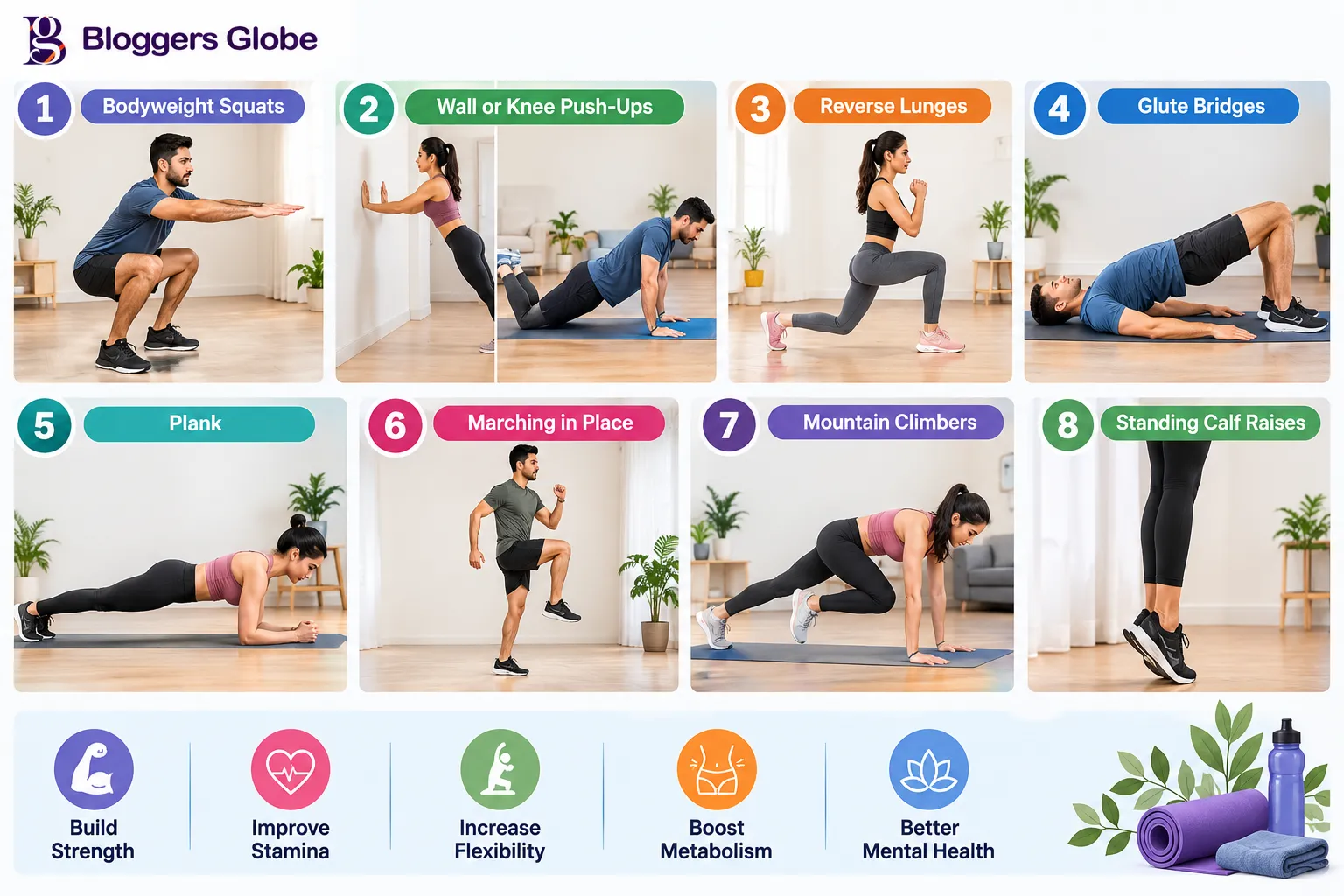
1. Bodyweight Squats
Squats work the muscles of your thighs, hips, and buttocks. They also help you practise a movement used in everyday activities, such as sitting down and standing up.
-
Stand with your feet approximately shoulder-width apart.
-
Keep your chest lifted and your back in a comfortable, neutral position.
-
Bend your knees and hips, lowering yourself as far as you can comfortably manage.
-
Push through your feet to return to standing.
Beginner target: 8–12 controlled repetitions.
2. Wall or Knee Push-Ups
Push-ups strengthen the chest, shoulders, triceps, and core. Standard push-ups can be challenging at first, so start with wall push-ups or knee push-ups if needed.
-
Place your hands slightly wider than shoulder-width apart.
-
Keep your body aligned and your core gently engaged.
-
Bend your elbows to lower your chest towards the wall or floor.
-
Push back to the starting position without rushing.
Beginner target: 6–10 repetitions using a variation you can perform with good control.
3. Reverse Lunges
Reverse lunges train the legs and glutes while challenging balance. They can be easier to control than forward lunges for some beginners.
-
Stand upright with your feet hip-width apart.
-
Step one foot backwards and bend both knees within a comfortable range.
-
Keep your front foot planted and your torso steady.
-
Return to standing and repeat on the other side.
Beginner target: 6–8 repetitions per side. Hold a stable surface for balance if necessary.
4. Glute Bridges
Glute bridges strengthen the glutes and work the muscles around the hips. They are performed lying on your back, making them a useful low-impact option.
-
Lie on your back with your knees bent and feet flat on the floor.
-
Keep your arms relaxed by your sides.
-
Lift your hips by pressing through your feet.
-
Pause briefly at the top, then lower your hips slowly.
Beginner target: 10–15 repetitions.
5. Plank
The plank trains your core muscles, which help support your torso during movement. You can begin with a wall plank or a plank performed with your knees on the floor.
-
Place your forearms on the floor and keep your elbows under your shoulders.
-
Extend your legs or keep your knees down for an easier variation.
-
Keep your body aligned without letting your lower back sag.
-
Breathe normally and stop when you can no longer maintain good form.
Beginner target: Hold for 10–20 seconds, then rest.
6. Marching in Place
Marching in place is a simple way to increase movement and raise your heart rate without running or jumping. It is useful for beginners and people who prefer low-impact exercise.
-
Stand tall and march by lifting one knee at a time.
-
Swing your arms naturally.
-
Start slowly and increase your pace only if comfortable.
Beginner target: 45–60 seconds.
7. Mountain Climbers
Mountain climbers combine core work with a cardio challenge. They can be performed slowly at first, without trying to move at maximum speed.
-
Start in a high plank position with your hands under your shoulders.
-
Bring one knee towards your chest.
-
Return that foot and alternate sides.
-
Keep your hips as steady as possible.
Beginner target: 20–30 seconds at a controlled pace. If this position is uncomfortable, replace the exercise with marching in place.
8. Standing Calf Raises
Calf raises strengthen the muscles at the back of your lower legs and require no equipment.
-
Stand with your feet hip-width apart.
-
Hold a wall or sturdy chair for balance if needed.
-
Raise your heels slowly, then lower them with control.
Beginner target: 12–15 repetitions.
20-Minute Full-Body Home Workout
This sample routine combines strength exercises and simple cardio. Adjust the number of repetitions and rest periods to match your fitness level. The timings are approximate, so it is fine if your first session takes a little longer.
| Stage | Exercise | Time or Repetitions |
|---|---|---|
| Warm-up | Marching, arm circles, gentle step movements | 3 minutes |
| 1 | Bodyweight squats | 10 repetitions |
| 2 | Wall or knee push-ups | 8 repetitions |
| 3 | Reverse lunges | 6 per side |
| 4 | Glute bridges | 12 repetitions |
| 5 | Plank | 15–20 seconds |
| 6 | Marching in place | 1 minute |
| Cool-down | Gentle walking and comfortable stretches | 3 minutes |
Complete the exercises in order, resting for about 30–60 seconds when needed. If you have enough time and energy, you may repeat the strength exercises for another round. Beginners can start with one round and build up gradually.
Stop if you experience chest pain, dizziness, unusual shortness of breath, or sharp pain. Exercise should challenge you without forcing you to ignore warning signs.
Easy Modifications for Beginners
You do not need to perform every exercise at its hardest level. A suitable modification allows you to practise the movement while maintaining control.
-
Squats: Sit down towards a stable chair and stand back up.
-
Push-ups: Use a wall instead of the floor.
-
Lunges: Take a smaller step and hold a sturdy surface for balance.
-
Planks: Keep your knees on the floor or use a wall.
-
Cardio: March in place instead of jumping or running.
If you have a chronic health condition, a recent injury, or difficulty with balance, ask a qualified healthcare professional about suitable exercises before starting a new routine.
Simple Weekly Workout Plan
A weekly plan can help you balance strength exercises, cardio, mobility, and recovery. The following is a flexible example for a beginner who is comfortable with light to moderate activity.
| Day | Activity |
|---|---|
| Monday | Full-body bodyweight workout |
| Tuesday | Brisk walking or low-impact cardio |
| Wednesday | Bodyweight strength and core exercises |
| Thursday | Rest or gentle mobility work |
| Friday | Full-body home workout |
| Saturday | Walking, cycling, dancing, or another enjoyable activity |
| Sunday | Rest or gentle movement |
Adjust this plan according to your fitness, schedule, and recovery. You do not need to train hard every day. Regular movement throughout the week, combined with enough rest, is a more sustainable approach than pushing yourself too hard at the beginning.
For more ideas on fitting exercise into a busy schedule, read our guide to healthy lifestyle habits for busy professionals.
How to Make Progress Without Equipment
Your body can adapt to exercise over time. Once a workout starts to feel easier, you can make gradual changes to keep it challenging without needing weights or machines.
-
Improve your technique: Use a comfortable range of motion and control each repetition.
-
Add repetitions gradually: Increase your total only when you can complete the current amount with good form.
-
Increase time carefully: Add a few seconds to a plank or cardio interval as your endurance improves.
-
Choose a harder variation: Move from wall push-ups to lower-supported or knee push-ups when ready.
-
Track your sessions: Record exercises, repetitions, and how difficult the workout felt.
-
Allow recovery: Take rest days and avoid training the same muscles hard when they are still very sore.
Progress is not always about doing more. Better balance, improved control, easier daily movement, and greater consistency are also useful signs of improvement.
What to Eat Before and After a Workout
Exercise and nutrition work together. You do not need special supplements to complete a basic home workout, but eating balanced meals and drinking enough water can support your energy and recovery.
Depending on your schedule and appetite, a light snack such as a banana or yogurt may be suitable before exercise. After your session, choose a balanced meal that includes protein, carbohydrates, and other nutrient-rich foods.
For practical meal ideas, see our guide to the best foods to eat before and after a workout.
Common Home Workout Mistakes
Skipping the Warm-Up
Starting intense movements with cold muscles can make the session feel uncomfortable. Begin with a few minutes of easy movement and gradually increase your pace.
Doing Too Much Too Soon
Trying to complete a demanding workout on your first day can lead to excessive soreness and make it harder to maintain the habit. Start with a manageable amount and increase it gradually.
Ignoring Proper Form
Fast repetitions are not necessarily better. Prioritize controlled movement, comfortable alignment, and a suitable exercise variation.
Expecting Instant Weight Loss
One workout will not transform your body overnight. Changes in fitness and body weight depend on consistency, nutrition, sleep, daily activity, and individual factors.
Forgetting Recovery
Your body needs time to recover from training. Adequate sleep, rest days, and balanced meals help you maintain a routine over the long term.
Frequently Asked Questions
What is the best home workout without equipment?
A good starting routine combines squats, modified push-ups, lunges, glute bridges, planks, and low-impact cardio. The best combination depends on your fitness level, goals, and any physical limitations.
Can I build muscle at home without weights?
Bodyweight exercises can improve strength and build muscle, particularly for beginners. Progress may become more challenging as you get stronger, so you may need harder exercise variations, greater training volume, or external resistance to continue progressing.
How long should a home workout last?
A beginner can start with 10–20 minutes per session and gradually increase the duration. Your ideal workout length depends on your goals, intensity, schedule, and recovery.
Can home workouts help with weight loss?
Yes. Home workouts can contribute to weight management by increasing physical activity and helping preserve muscle. Weight change also depends on food intake, daily movement, sleep, and other individual factors.
How many days a week should I work out at home?
Start with two or three structured sessions per week if you are new to exercise, then increase gradually as your fitness improves. Include lighter activity and recovery days as needed.
Do I need to work out every day to stay fit?
No. You can build a healthy fitness routine with regular exercise spread across the week. Walking and other light activities can complement structured workouts, while rest days allow you to recover.
Final Thoughts
The best home workouts without equipment are simple enough to start today and flexible enough to maintain over time. Squats, push-ups, lunges, glute bridges, planks, and marching in place can form the foundation of an effective routine.
Focus on proper technique, choose beginner-friendly variations, and increase the challenge gradually. Combine strength exercises with cardio, balanced nutrition, sufficient sleep, and regular recovery to support your overall fitness.
You do not need a perfect workout or an expensive setup. Start with the time and space you have, stay consistent, and build your routine one session at a time.